
You know exactly who you'd want
The list exists. It just lives in Courted, BrokerMetrics or MarketView instead of your calendar.
Recruiting appointments for real estate brokers, booked straight onto your calendar.
The real problem
You already have the list of agents you'd want on the team. That shortlist has been there for a year. It hasn't moved.
The list exists. It just lives in Courted, BrokerMetrics or MarketView instead of your calendar.
Cold outreach is hard. So it happens in bursts. A good week in January, then nothing until April.
A deal falls through. A quarter goes sideways. A manager shows up they can't stand. You can't see any of it coming.
Not someone better. Just someone still around when it mattered the most.
You are almost never in their phone the month they decide it's time for a change.
Here is the part nobody says
Put a broker in a booked appointment with an interested agent and they close. You know your market, you know your numbers, and you have had this conversation a hundred times.
Nobody needs help running the meeting. Everybody needs help getting to it.
Texting Betty does the half you hate. You do the half you're good at.
Why this works
01
An unknown number calling a working agent goes to voicemail and stays there. A text sits in their thread until they open it. They always open it.
02
A person gives up after two unanswered follow-ups, because by the third it starts to feel desperate. Betty is still there in month six, the week the split gets cut.
03
A broker can hold maybe ten real recruiting conversations at once, in a good month. Betty holds every agent on the list at the same time, and none of them go cold because something else came up.
Recruiting doesn't go to the most convincing broker. It goes to the one still in the conversation.
How it works
Pull it from Courted, BrokerMetrics, MarketView, or your own CRM. However messy it is, we validate every number, drop the duplicates and dead lines, and remove anyone you don't want contacted.
We write the sequence around what makes your brokerage worth moving to. Then we watch what earns replies and what gets ignored, and keep rewriting until it works.
She introduces herself as a talent scout working with you, then texts, replies, handles objections, and follows up for months. Not a blast. One agent at a time.
When an agent is interested, we put the meeting on your calendar, inside the availability you set. That part is your entire job.
The math
You already know what one producing agent is worth to your brokerage over twelve months. Keep that number in mind.
An in-house recruiter costs $60,000 a year and up. That is before you count the months of ramp up, the time you spend managing them, and the fact that most leave long before they finish a nine month follow up sequence.
Betty is one flat monthly fee. Not per appointment, not per message, not per agent hired. Book two meetings this month or twenty, the number at the bottom of the invoice does not change.
Run your own number
For most brokerages this is the cap, or the company dollar per agent.
Your plan
1 agent pays for the year.
Growth is $11,988 a year. At $12,000 kept per agent, 1 covers it.
A steady campaign puts five to ten of these conversations in front of you every month. About 20 out of every 100 become a hire.
Growth
For teams recruiting steadily
Scale
For multi-office brokerages
Enterprise
For large organizations
No setup fee. Month to month.
Your cost is fixed. Your pipeline isn't.
Proof
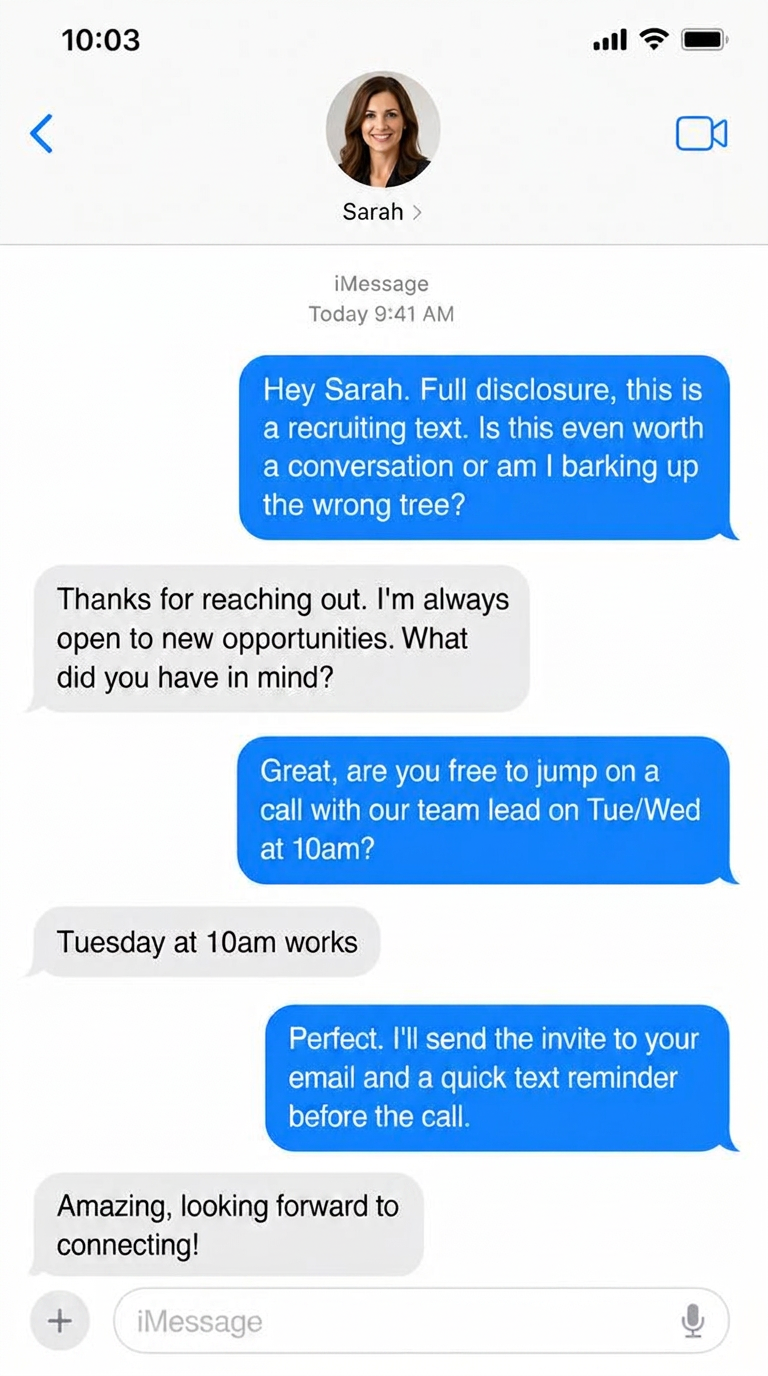
Disclosure first. Reply second. Call booked.
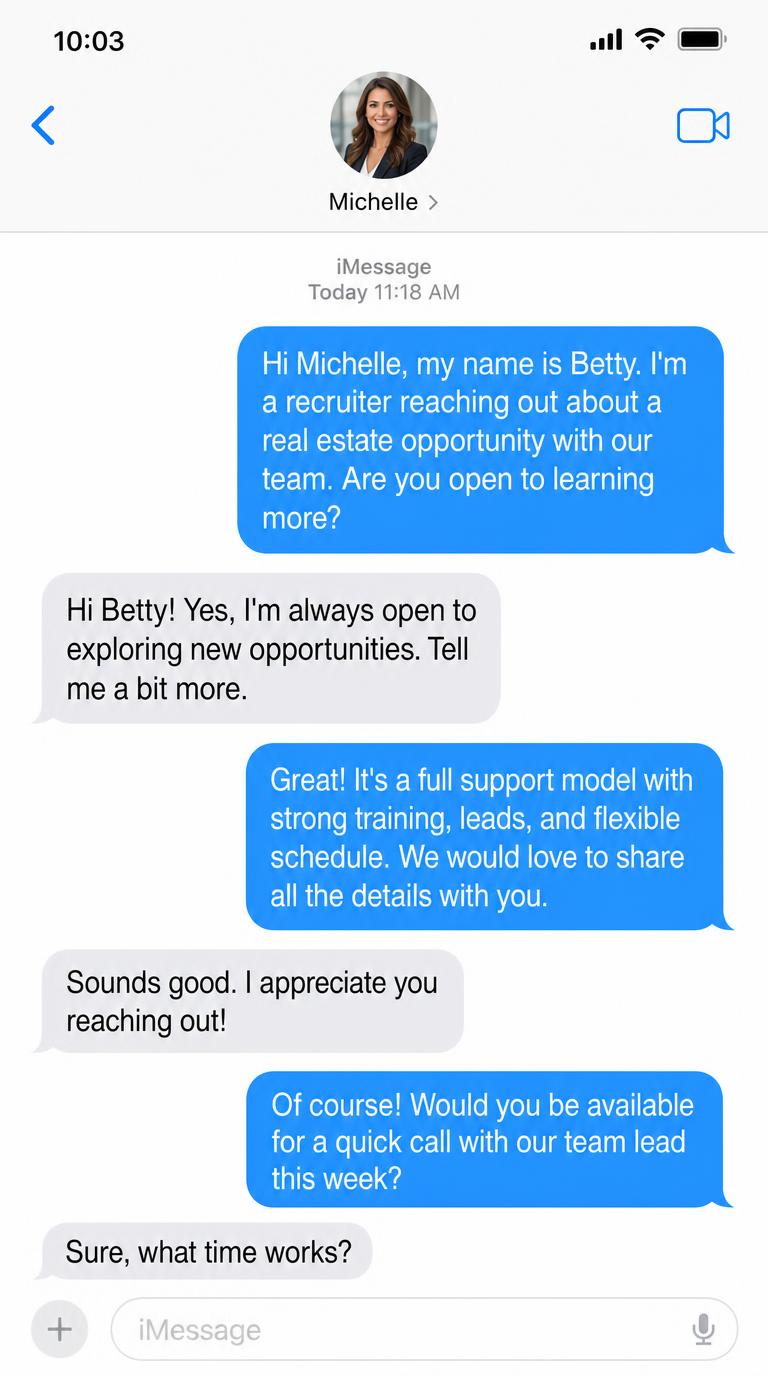
Intro, opportunity, call request.
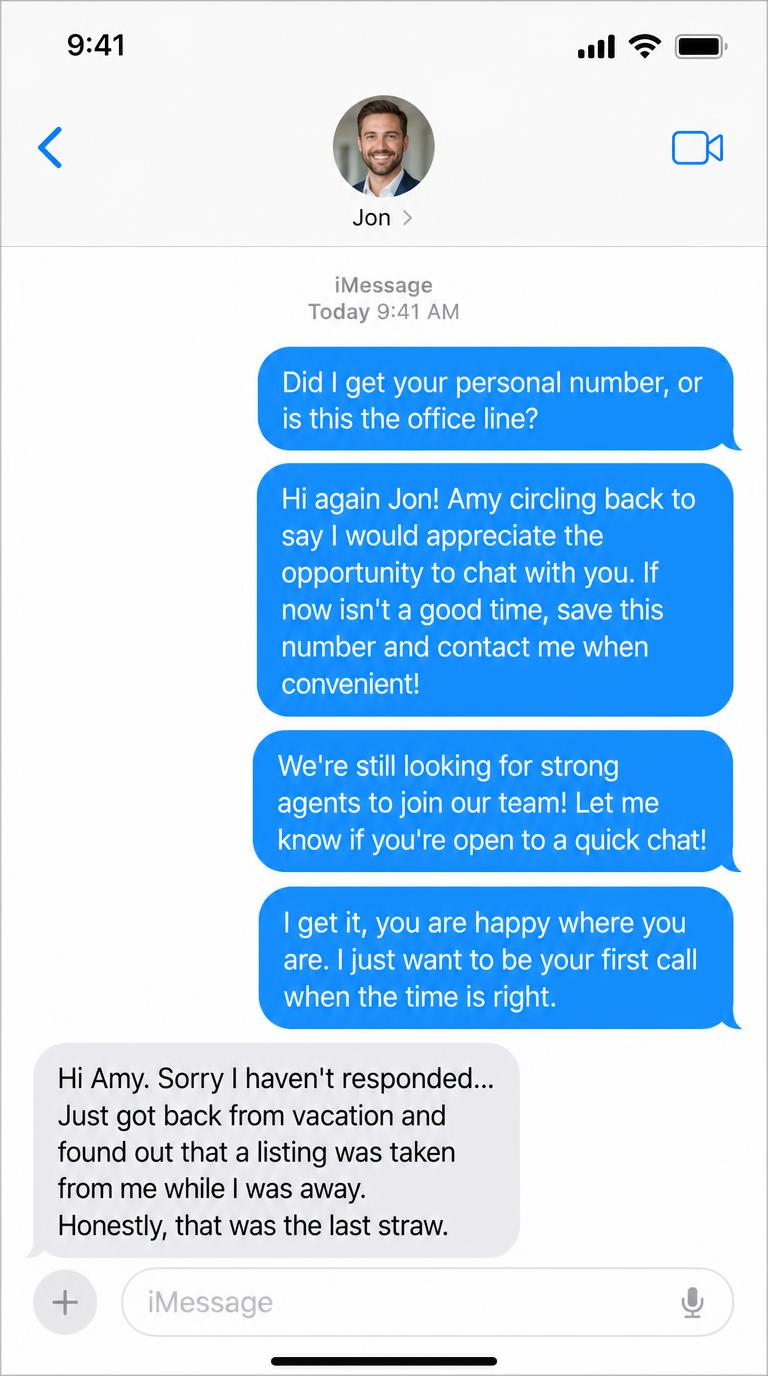
Persistent follow-up, then the moment it mattered.
53%
of booked appointments come from message five or later
This is why consistency is the product, not the pitch.
"We booked more recruiting appointments in one quarter than in the two years of cold phone calls and texts."
"The agents thought they were texting my office. That is exactly what I wanted."
"My only job now is showing up to the meeting and delivering the pitch."
THE QUESTIONS EVERY BROKER ASKS
9 in 10
booked calls actually happen
2 per 100
agents we contact end up booking a call
15-30%
of those calls turn into a hire
About 9 out of every 10 booked calls happen.
We only book a call after an agent tells us they want to talk. So by the time the meeting is on your calendar, the agent already knows who you are and why you are calling.
Your account manager also sends a reminder before the call, and tells the agent what number you will be calling from. If an agent does miss the call, we reach out the same day and set a new time.
About 9 out of 10 booked calls happen.
About two calls for every 100 agents we contact.
That is two per 100 agents, not two per 100 messages. Each agent gets five to seven messages over a few weeks. So 100 agents means a few hundred messages, a smaller number of real conversations, and about two booked calls at the end of it.
Most agents who reply do not reply to the first message. They reply to the fourth or the fifth.
Depending on the size of your list, you can expect five to twenty plus calls a month, every month. The size of your list sets the limit here, not how hard we work it.
A 30 agent team booked 48 calls in their first 60 days, from a list they already had.
Between 15 and 30 out of every 100 calls turn into a hire. We tell clients to plan on 20. So ten calls a month is about two new agents a month.
Here is the split. Getting a good agent on the phone with you is our job. What happens on that call is your job.
Clients at the high end usually have an offer that is easy to explain in one sentence, and they get back to agents fast. Clients at the low end are being picky on purpose. That is a fair choice. It just means they need more calls to reach the same number of hires.
On average team leaders hire 20% of agents they interview
You give it to us.
Most brokerages already have better data than we could buy for them. Courted, BrokerMetrics, MarketView, an MLS export, or a cheaper agent list all work fine.
We used to sell list building as a paid service and we stopped. Clients can pull the same list themselves in about twenty minutes, and our skill is texting, not data.
What we do give you is the exact filters to use. Before you export anything, we tell you which production range to set, which area to cover, and, if your tool has it, how likely an agent is to move. In Courted we use high and moderate, and skip low. We also ask for under 1,000 rows at a time, so the file does not get cut off without you noticing.
Send the file exactly as it comes out. We need a name and a mobile number. Anything else you have is useful too, like production, brokerage, years in the business or email. We send that back to you when we book the call, so you know who you are about to talk to.
We give you the export filters before you pull the list.
3,000 contacts.
Here is why. Each agent gets five to seven messages. Then they rest for about three months before we contact them again, with new wording and from a new number. That rest is what keeps opt outs low and keeps your name in good standing in your market.
It also means a list gets used up at a steady rate. A few hundred names lasts about two weeks. After that there is nobody left to talk to, no matter how hard we work.
If your market comes up short of 3,000, we would rather fix that before we start than after. Usually it means widening the area, opening up the production range, or adding a nearby market you would hire from anyway. Most brokerages can go wider than their first export suggests, especially when their agents do not come into an office.
3,000 contacts keeps a campaign running. If you are short, we tell you before you pay.
Yes, and please do.
Send us your current agents, your past agents, anyone you are already talking to, and anyone else you would rather we left alone. There is no size limit and no set format. You can add names at any time, not just at the start. Nobody on that list gets a message from us.
This matters more than it sounds. The most common problem in recruiting outreach is not a bad message. It is a good message sent to someone the broker met last month.
We also take numbers out on our own: shared office numbers, landlines, internet phone lines and CRM numbers. Those almost never lead to a call, and they often reach the wrong person.
Send names at any time. We apply them the same day.
Yes. You get a dedicated human account manager.
The AI handles the conversation up to the point where an agent says they want to talk to you. Then a real person takes over. It is the same person every time, so you never have to explain your business twice.
Your account manager reads every conversation that gets that far. They book the call in the calendar you already use. They remind the agent before the call. They follow up on no shows and set a new time. And they step in on any message the AI should not be answering.
They work with you by text, or by email if you prefer. There is no dashboard to log into and no software for your team to learn.
You get a human account manager
Some agents reply and say call me right now. Those are worth catching.
Your account manager texts you first to see if you are free. If you are, we set it up on both sides. The agent knows your name and the number you will be calling from, and is waiting for the phone to ring.
If you are not free, we book that agent into your calendar instead.
We never tell an agent you will call unless you have said yes. A call that never comes tells the agent the whole thing was automated, and that is very hard to come back from.
A live handoff when you are free. A booked time when you are not.
We compare your campaign against every other campaign we run.
We run recruiting campaigns for teams and brokerages across North America. That tells us what a normal reply rate looks like this month, in a market like yours, for an offer like yours. If your campaign drops below that line, we see it in the numbers before you see it as a quiet calendar. Then we change something: the first message, the timing, the angle, or which agents we are working through.
We also refresh campaigns. One campaign runs for about a month. Then those contacts rest. When they come back around, the campaign has been rebuilt with new wording, a new angle and a new phone number, so it does not read as the same pitch from the same company again.
This is needed because messages wear out. A first line that works well in the spring can stop working by the fall, partly because other companies copy whatever is working. Running a lot of campaigns at once is how we catch that early and rewrite before your results drop.
You do not have to manage any of this or approve each change. We tell you when something important changes.
Your campaign is measured against every campaign we run.
Three to five business days after we have your list and your information. Conversations start the same week the campaign goes live. Calls follow the message schedule, so week one is quieter than week three.
Team leaders usually see the first appointments booked within a week of campaign launch
Two things. Your agent list, and anything that explains why an agent should join you.
That second part can be a website, a PDF, a recruiting video, an old job ad, or notes in an email. Send it however it already exists. We turn it into the information the AI works from, then send it back for you to read. Nothing goes out until you approve it.
Most clients finish their part in one sitting.
That is what the call is for. Thirty minutes, no slide deck, and you will leave knowing what your market can really produce.
Book a strategy call
Book a twenty-minute strategy call. We'll look at your market, size the list, and show you exactly how Betty can help grow your team.